
Inside Sesimi - Latest News and Stories
Stay up to date with the latest news and insights from the Sesimi team.
Where Governed Content Breaks | CMS Connect 2026
Published on 18 Aug 2026 by Sesimi Editorial
Most organisations have systems for managing approved content. Problems start when a dealer, franchisee, partner or store manager needs to turn that content into an advertisement, email, social post or other customer-facing asset.
At CMS Connect 2026 in Montreal, Sesimi’s Director of North American Sales, Mike Thompson examined where brand governance breaks down when the approved production route is slower than the local workaround. Forrester VP and Principal Analyst Chuck Kahun later linked Mike’s argument to the content problems clients are raising with Forrester.
| AT A GLANCE |
| Governance often breaks between central systems and local production. |
| Manual review cannot keep pace as channels, formats and local variations multiply. |
| Local teams use governed workflows when they provide a faster route to market. |
The source of truth does not always reach the customer
A content management system (CMS) may hold approved pages and messaging. A product information management (PIM) system may hold current product data and pricing. A digital asset management (DAM) system may hold the correct logos, images and campaign assets. All three can work as intended while a local advertisement reaches customers with an outdated offer, the wrong image or an improvised brand treatment.
Examples from the room included sales teams modifying PowerPoint decks, executives generating off-brand material with AI and advertising assets stored in front-end code that marketing teams could not easily locate.
Mike also pointed to sales representatives using PDFs saved years earlier, even after product details, service agreements or features had changed. When approved content is unavailable inside their production tools, people use whatever they already have.
Storage alone does not protect the finished asset. Approved prices, images and messaging need to reach the tools used to create it. As explored in Sesimi’s perspective on local area marketing across distributed networks, governance works best during production, before incorrect content reaches the approval queue.
Your source of truth is only as good as the last mile it survives.
Asset-by-asset review cannot keep pace
A national campaign rarely remains a single asset. Local offers, regional imagery, different dimensions and channel-specific calls to action can turn one campaign into dozens or hundreds of variations. Every version creates another opportunity for outdated information or an incorrect brand treatment to reach customers.
Manual approval catches mistakes one asset at a time. Every variation must be submitted, reviewed, corrected and resubmitted while local teams wait to promote available stock, upcoming events or time-sensitive offers.
The audience discussion returned to why people bypass these processes. Sales teams may need a presentation immediately but wait weeks for an approved version that meets their requirements. As Mike noted, they have not been given a route easier than the workaround.
Local deadlines continue when the approval queue is full. If producing an advertisement independently is faster than following the approved process, some teams will work outside it. More checks increase the review workload without addressing the delay that caused the workaround.
Sesimi’s analysis of brand management after Cannes Lions 2026 identified the same pressure. More audiences, markets and channels mean more assets to manage. Brand controls need to operate during production to keep pace.
What one automotive account revealed
Mike used an Australian automotive account to show how this problem affects a dealer network.
The brand had strict global guidelines and a national dealer marketing system. Most dealers followed the approved process, but some produced local advertising independently. The resulting ads did not align with national campaigns or the work produced by other dealers.
Local advertisements could spend two to four weeks moving between dealers and head office for review, corrections and resubmission. Some dealers bypassed the system. Others stopped advertising rather than risk breaching the brand guidelines.
Storing the correct price and image in a DAM does not help a dealer at 9pm on a Friday unless that content reaches the tool used to create the asset.
– Mike Thompson, Sesimi Director, North America Sales
The brand turned approved campaigns into templates connected to its central content sources. Dealers could select the relevant vehicle, imagery and approved local options, while product information, campaign copy and disclosures remained controlled. According to Mike, local assets could then be produced in minutes rather than waiting weeks for manual approval.
Dealers gained faster access to campaigns. Head office gained greater confidence in how the brand appeared across local markets. The approved process became a practical way for dealers to complete the work already expected of them.
What Is: Governed local production
Governed local production allows local teams to adapt approved campaign assets while head office controls brand identity, product information and compliance-sensitive elements.
Three changes that close the last-mile gap
“You want to be able to push that content to where people are actually building.”
– Mike Thompson, Sesimi Director, North America Sales
The session identified three practical changes for dealer, franchise, partner and multi-location networks:
- Connect approved content to local production. Current prices, images, product information and legal copy need to reach the tools local teams use. Sesimi’s creative automation tools connect approved content with adaptable templates, removing the need to re-enter or reconstruct it elsewhere.
- Control the elements that create risk. Logos, colours, product data, pricing, legal text and mandatory disclosures may require central control. Offers, store details, calls to action and selected imagery can remain adaptable where local knowledge improves relevance.
- Leave local decisions with local teams. Dealers and franchisees understand their inventory, customers, competitors and local conditions. A governed workflow should handle brand-critical decisions centrally without removing useful local control.
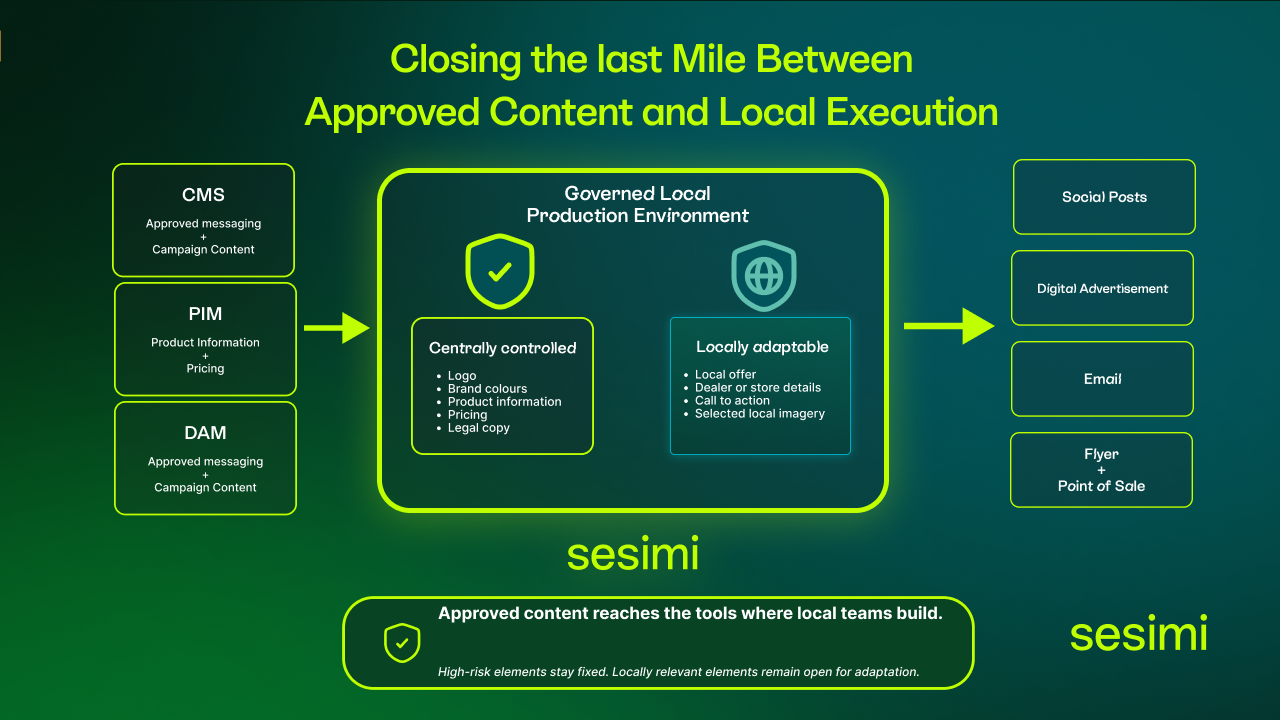
Approved content needs to reach the tools used for local production, with central control applied only where changes create brand, accuracy or compliance risk.
This model also helps connect marketing strategy with frontline execution. Local teams get faster access to approved material, with clear boundaries around what they can change.
Stop trying to catch off-brand content after it ships. Make on-brand the easiest thing in the room.
A two-question test for every content element
The session reduced the decision to two questions:
- Could changing this element put the brand, legal compliance or product accuracy at risk? If yes, control it centrally.
- Does this element need local knowledge to remain relevant? If yes, make it adaptable.
Apply the test to each element rather than locking or opening the entire asset. The logo and mandatory legal text can remain fixed while dealership details, calls to action and selected imagery reflect the local market. Product information can flow directly from the central source.
The fastest route should also be the compliant route
Mike closed with two questions: who is producing brand assets that never touch the organisation’s CMS, PIM or DAM, and what prevents the central team from reaching them?
Dealers, franchisees and store managers still need to respond to local opportunities. When approved content cannot reach them in time, they find another way to produce the work.
Repeated workarounds become part of the content supply chain, even when head office cannot see them. Closing the last mile means bringing approved content into local production, controlling brand-critical elements and keeping locally relevant elements adaptable.
When the approved process supports the work local teams need to complete, they can move quickly without leaving the governed workflow.
FAQ
What is the last mile of the content supply chain?
The last mile of the content supply chain is where approved pages, product data, images and brand assets become customer-facing local marketing. It includes advertisements, emails, flyers and social posts produced by dealers, franchisees, partners, branches and store teams.
Why can manual approval encourage off-brand workarounds?
Manual approval can encourage off-brand workarounds by delaying time-sensitive local campaigns. When every asset requires submission, review, correction and resubmission, local teams may use old files or create new material outside the governed system.
What should be controlled centrally and what should local teams be able to change?
Brand, legal, compliance and product-critical elements should be controlled centrally, including logos, product data, pricing and mandatory legal copy. Local teams should be able to adapt store details, selected imagery, calls to action and approved offers where local knowledge improves relevance.
Close the Gap Between Approved Content and Local Execution
Sesimi connects approved campaigns, product data and brand controls with the tools dealers, franchisees and local teams use to create marketing.

Read other relevant blog posts:
 What AADA 2026 Signals About the Future of Dealer MarketingExplore what AADA 2026 signals for dealer marketing, from local strategy + faster execution to smarter spending, connected systems + measurement.
11 Aug 2026 • Sesimi Editorial
 What Cannes Lions 2026 Revealed About the Future of Brand ManagementCannes Lions 2026 showed how AI, creators and connected platforms are changing brand management for enterprise and distributed marketing teams.
8 July 2026 • Sesimi Editorial
 What Franchise Leaders Are Prioritising in 2026: Insights from FGMCInsights from FGMC 2026 reveal how franchise brands are improving local execution, franchisee adoption, data visibility, AI readiness, and business performance.
16 June 2026 • Sesimi Editorial