
Inside Sesimi - Latest News and Stories
Stay up to date with the latest news and insights from the Sesimi team.
The Visibility Gap in OEM Dealer Marketing
Published on 1 Sept 2026 by Sesimi Editorial
Head office creates national campaigns, sets brand standards and remains accountable for compliance. Dealers then adapt those campaigns to local inventory, offers, events and market conditions, often through processes head office cannot fully see.
Sending every local change back to an agency or central marketing team slows production and increases costs. Work produced outside the approved process is faster but harder to track, govern and measure. OEMs need a model that gives dealers a practical route to market while preserving brand control and visibility across the network.
| AT A GLANCE |
| Jaguar Land Rover Australia reduced campaign production from three to four weeks to one to two weeks, with its fastest campaigns completed in two to three days. |
| Kubota Australia and New Zealand coordinates national campaigns and local marketing across more than 140 dealerships. |
Where the traditional OEM campaign model slows down
National campaigns rarely reach local markets unchanged. Dealers may need to update vehicle models, inventory, finance offers, event details, locations, calls to action or legal information before the creative is relevant to their customers.
Each campaign may also require social posts, display advertisements, emails, outdoor placements, showroom posters and website banners. Across a dealer network, one national campaign can generate hundreds or thousands of local variations.
In a traditional production model, every change enters an agency or internal design queue. The dealer submits a brief, a designer adapts the creative, head office reviews it, corrections return to production and the dealer waits for approved artwork.
The workflow creates four problems:
- Campaigns reach local markets after the relevant inventory, offer or event has changed.
- Repetitive adaptations consume time that agencies and internal teams could spend on campaign planning and dealer support.
- Dealers use old files, local designers or improvised creative when the approved route cannot meet their deadline.
- Head office cannot reliably see which campaigns are adapted, activated or ignored across the network.
Distributing approved assets does not prove that dealers use them. National campaigns may sit untouched in a digital asset management system while local teams rely on saved files, agency artwork or materials produced outside the approved process. Head office can see what it supplied, but not always what reached the market.
National campaign cycles and local sales conditions move at different speeds. Dealers respond to stock arrivals, competing offers and changes in local demand, often within days.
Jaguar Land Rover Australia faced this tension across a network of more than 30 retailers. Its previous campaign process typically took three to four weeks, limiting how quickly retailers could respond to local opportunities. After changing the workflow, production fell to one to two weeks, with the fastest campaigns completed in two to three days. The Jaguar Land Rover Australia case study shows how a more efficient production route can increase dealer speed while maintaining central oversight.
Why tighter approvals do not solve the problem
Manual review can catch an incorrect logo, expired offer or missing disclaimer. It cannot prevent the error or reduce the work required to find it.
As dealer requests, channels and formats multiply, so does the approval workload:
- A dealer requests an adaptation.
- A designer changes the creative.
- Head office reviews the asset.
- Corrections return to production.
- The dealer waits for approval.
Compliance depends on the creator interpreting every guideline correctly and the reviewer catching every mistake.
Governed templates lock logos, colours, typography, product data, legal copy and layout rules while allowing dealers to edit approved local fields. Embedding brand compliance within production prevents common errors and reserves manual review for genuine exceptions.
What head office should control + what dealers should adapt
OEMs need a consistent method for assigning control:
- If an element carries brand, legal, pricing or data risk, control it centrally.
- If it depends on current local knowledge, make it adaptable within defined limits.
| Centrally controlled | Locally adaptable |
|---|---|
| Logos + marque identity | Dealer details |
| Brand colours + typography | Local inventory |
| Approved product imagery | Local events |
| Vehicle specifications | Geographic information |
| Mandatory legal copy | Calls to action |
| Finance disclaimers | Approved local offers |
| Campaign expiry rules | Selected imagery where permitted |
| Required layout relationships | Channel + format selection |
Local flexibility does not require unrestricted editing. Fields can provide approved vehicle selections, validated pricing data, character limits or images from a central asset library. Templates can apply the correct disclaimer to a selected finance offer, while expiry rules prevent outdated campaigns from returning to market.
Head office retains control over the marque, campaign structure and regulated content. Dealers supply the local information needed to turn national creative into relevant advertising.
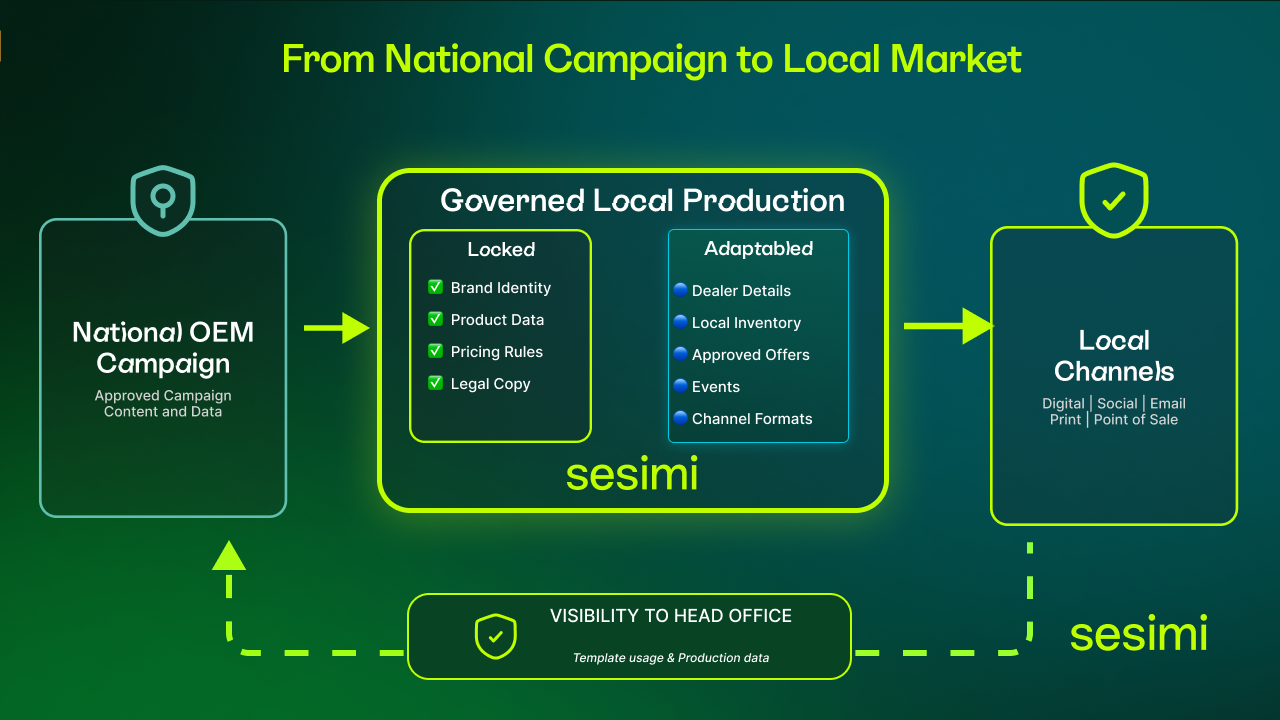
A governed dealer marketing model separates brand-critical campaign elements from the information dealers need to adapt locally.
Governance only works when dealers use the approved route
A governed dealer marketing platform cannot improve control while the network relies on email requests, saved artwork, local agencies and files stored on individual computers. Campaign activity remains divided between download records, agency jobs, approval emails, co-op claims and local files, leaving no single view of what the network produces or where national campaigns reach customers.
Adoption depends on operational value. The approved route must be the fastest way for a dealer to promote a new vehicle, update an offer or produce materials for a local event.
Uploading national creative is not enough. Dealers need access to campaigns relevant to their marque, region and location, supported by current product and legal information. Expired materials must be removed, and templates must be usable without design training.
Kubota Australia and New Zealand addressed this by combining a central source of approved assets with customisable templates for local campaign production. More than 140 dealerships gained a practical way to create local marketing while following national brand standards. This reduced reliance on manual production and gave the central team greater visibility across the network. Sesimi’s Creative Automation shows how local flexibility and stronger brand governance can work together.
The controlled self-service route gave dealers speed and flexibility while improving consistency across the network. Campaign funds previously spent recreating approved creative could instead support distribution and reach.
Training should focus on real campaign tasks rather than platform features. Reporting should identify inactive locations, abandoned work and templates that require frequent support. These signals show where the approved process remains slower, less relevant or harder to use than the workaround.
Measure what happens after campaign distribution
Publishing a national campaign to a portal or DAM confirms availability, not activation. An OEM may know which assets dealers downloaded without knowing whether they were adapted, approved, published or replaced with local creative.
Campaign activity may also be split across agency requests, approval systems, co-op fund processes and dealer-owned tools. Each system records one part of the workflow, leaving head office without a complete view across the network.
OEM marketing teams need to measure what happens between national campaign release and local activation:
- Time to market: How long dealers take to produce local assets after a campaign becomes available.
- Network adoption: Which dealers and locations use the approved environment.
- Campaign utilisation: Which campaigns, templates and assets the network selects.
- Production volume: How many local assets are created without agency or head-office intervention.
- Brand compliance: Which errors or exceptions still require correction.
- Fund utilisation: Where marketing funds are claimed, left unused or disconnected from campaign activity.
- Network coverage: Which regions or dealer groups show limited or no campaign activity.
These measures make previously invisible activity useful. Low adoption may indicate problems with access, training or usability. Low campaign utilisation may show that national creative does not meet local requirements. Repeated edits may identify a template that needs redesigning, while unused funds may indicate that dealers lack suitable campaigns or cannot activate them quickly enough.
A connected platform can bring dealer advertising compliance, campaign distribution and co-op fund activity into a single environment. Centralised data gives brand teams clearer visibility into campaign adoption, pre-approval requests and final claims across the network. Sesimi’s Co-op Funds Management connects these workflows to improve governance and simplify dealer operations.
The goal is to identify where national campaigns stop moving, where local production leaves the approved environment and where dealers encounter gaps in campaign availability, usability or relevance.
AI increases the need for clear publishing authority
AI can accelerate campaign production, but it can also multiply incorrect content when dealers, agencies or automated systems generate copy, imagery and variations without clear controls.
OEMs need to define where AI can assist and where central or human authority remains necessary. AI may resize approved creative, generate variations within defined fields, translate controlled copy or recommend assets for a channel. Brand claims, vehicle specifications, pricing, finance information and legal disclosures require controlled sources, clear permissions and traceability.
The same risk-and-relevance test applies:
- AI can assist with adaptable elements within approved limits.
- Brand-critical elements must draw from controlled data, content and rules.
- Every generated asset should retain a record of its sources, changes, approval status and publisher.
- Automated publishing should follow the same permissions and expiry rules as human publishing.
Building these controls into the AI workflow allows OEM teams to reduce repetitive production work while retaining authority over what enters the market.
Build visibility into local campaign production
OEMs need to identify which decisions require central authority, encode those rules into the production environment and give dealers controlled flexibility over local information.
Production and visibility must remain connected. Head office needs to know which campaigns dealers use, how quickly they reach the market, where approved processes are bypassed and whether local activity supports investment in national campaigns and dealer funds.
As AI increases production volume, controlled data sources, permissions, adaptable fields, approval rules and publishing records will become essential. Central marketing teams can focus on designing the campaigns and controls the network needs, giving dealers a faster route to market and OEMs a clearer view of local campaign activity.
FAQ
What is OEM dealer marketing?
OEM dealer marketing is the production and activation of automotive campaigns across a manufacturer’s dealer network. Head office controls national campaigns and brand standards, while dealers adapt approved content for local inventory, offers, events and audiences.
How can OEMs maintain brand consistency across dealerships?
OEMs can maintain brand consistency by controlling logos, colours, typography, product data, pricing rules and legal copy within governed templates. Dealers can adapt approved local fields without changing brand-critical elements.
Why do dealers create off-brand marketing materials?
Dealers often create off-brand materials when approved campaigns are unavailable, difficult to adapt or too slow for a local opportunity. They may use old files, local designers or improvised artwork to meet an immediate need.
Build a faster route from national campaign to local market
Sesimi gives OEM marketing teams a governed way to distribute, localise and measure dealer campaigns without sending every adaptation through head office or an agency.

Read other relevant blog posts:
 The Brand Recognition Paradox: Why More Content Doesn't Build Stronger BrandsPublishing more content does not automatically build stronger brands. Discover why consistency, distinctive brand assets, and disciplined execution create lasting brand recognition.
13 July 2026 • Sesimi Editorial
 OEM Marketing in 2026: Five Trends Redefining Brand Control and Dealer SpeedFive OEM marketing trends shaping 2026, covering creative automation, dealer execution, governance, and compliance at scale.
30 June 2026 • Sesimi Editorial
 Sesimi Wins the 2026 DXP March Madness CompetitionHow multi location brands scale globally while maintaining brand consistency, localisation, and operational control.
20 Apr 2026 • Sesimi Editorial