
Inside Sesimi - Latest News and Stories
Stay up to date with the latest news and insights from the Sesimi team.
OEM Marketing in 2026: Five Trends Redefining Brand Control and Dealer Speed
Published on 30 June 2026 by Sesimi Editorial
5 OEM Marketing Trends Redefining Brand Control and Dealer Speed in 2026
OEM marketing models are being rebuilt under pressure. Central teams are expected to move faster, support dealers more directly, and maintain compliance across increasingly complex networks. Legacy agency models and fragmented tools cannot sustain this. he OEMs pulling ahead are not increasing output but restructuring how marketing operates.
| Quick Stats |
|---|
| 67% of manufacturers do not provide automated marketing tools to partners |
| 61% still rely on spreadsheets for reporting |
| Only 10% rate their channel measurement capability as excellent |
Why OEM Marketing Models Are Changing
OEM marketing is shifting from execution volume to operational design. At scale, the failure points are consistent. Tiered agency reproduction introduces delay and cost. Manual localisation cannot meet dealer expectations. Post production compliance creates rework and risk. Disconnected tools obscure accountability.
These are not isolated inefficiencies. They are structural limitations that emerge as networks scale, particularly in environments focused on scaling local marketing without slowing execution.
1. Creative Production Is Separating from Dealer Execution
OEMs are narrowing the role of central teams. The focus is shifting toward fewer, higher quality master assets that define campaign direction.
Reproduction is no longer treated as creative work. Historically handled by Tier 2 agencies or local teams, it introduced inconsistency, delay, and compliance risk across dealer networks.
At scale, this model fails. Execution now depends on removing repetition from the system, an approach aligned with modernising the brand kit for channel scale. Local teams require access to approved creative that can be adapted within predefined constraints, without manual recreation.
2. Dealer Speed Is Becoming a Measured Metric
Dealer speed is now observable and optimised. OEMs are measuring the time between campaign release and local activation. This includes asset discovery, localisation, compliance checks, and publishing.
Where this process breaks down, campaigns fragment across markets. Improvement is focused at the point of execution. Dealers are being given structured access to pre approved assets, with boundaries defined upstream. Layout, messaging limits, and compliance requirements are resolved before distribution. Speed becomes a function of system design, not exception handling.
3. Tiered Agency Models Are Being Reduced
Multi tier agency models introduce coordination overhead and limit visibility.
As dealer expectations increase, routine localisation tasks such as resizing, versioning, and applying local details are being reclassified as operational work.
These activities are being removed from manual workflows and absorbed into systems.
Strategic creative work remains with agencies. Execution work shifts toward automation, improving consistency and reducing turnaround time.
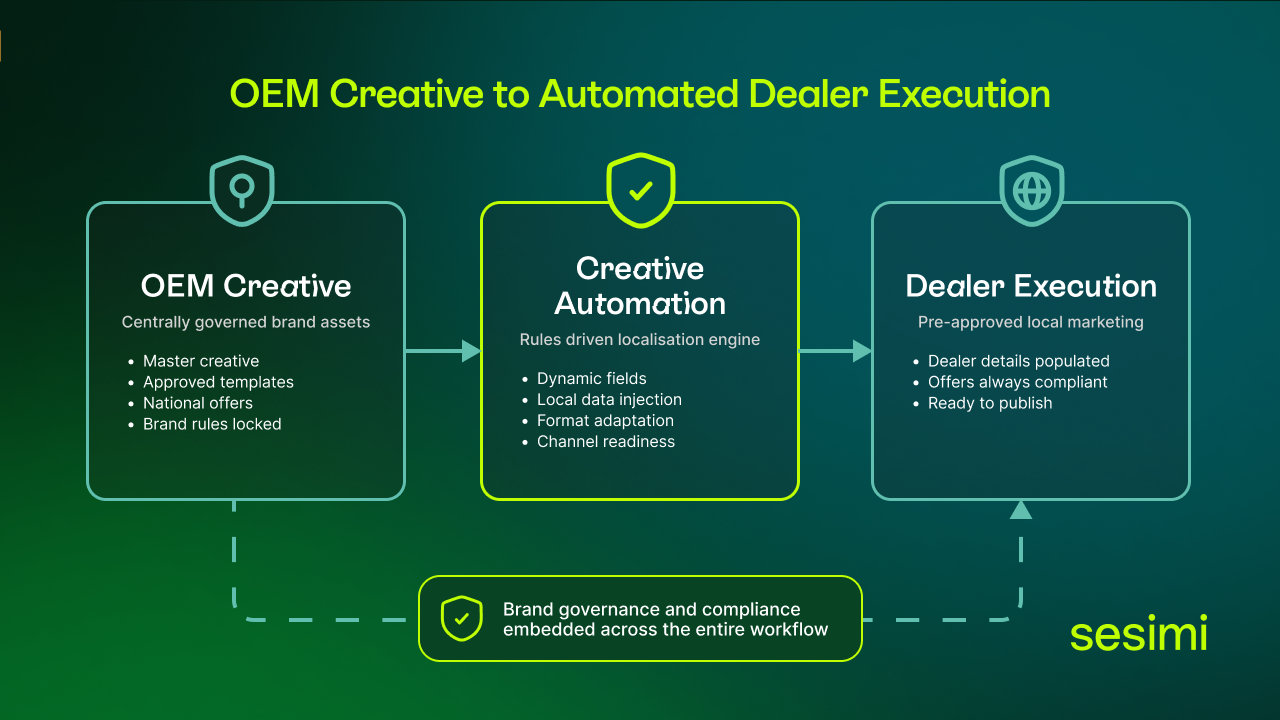 Diagram showing centrally governed OEM creative flowing into automated dealer level execution, with brand governance and compliance embedded at each stage of the workflow.
4. Compliance Is Moving Upstream
Compliance is no longer a final checkpoint. Regulatory requirements vary across regions and channels, making late stage validation inefficient. As content volume increases, post production checks introduce delay and inconsistency.
OEMs are embedding compliance into the creative process itself. Guardrails are defined before execution. Systems enforce requirements during content creation and adaptation. This reduces rework and ensures consistent execution across markets.
Compliance is shifting from review activity to system behaviour.
5. OEM Marketing Is Becoming an Operating System
The most significant change is structural. Marketing capability has historically been built through separate tools. Asset management, approvals, templates, and agency workflows operate independently.
At scale, this fragmentation limits coordination and visibility. OEMs are moving toward integrated operating models that connect assets, brand rules, automation, execution, and reporting into a single framework, reflecting broader shifts in AI driven brand management systems.
This approach improves oversight while enabling local autonomy within defined boundaries. It also provides a clearer view of what is live in market across dealer networks.
What This Means for OEM Marketing in 2026
OEM marketing performance is now defined by system design.
- Speed depends on how easily dealers can execute
- Control depends on how effectively rules are embedded
- Visibility depends on how connected systems are
The leading OEMs are not choosing between control and flexibility. They are building operating models that deliver both.
FAQ
What are the main challenges in OEM marketing at scale?
The main challenges in OEM marketing at scale are managing dealer execution speed, maintaining compliance across markets, reducing reliance on manual processes, and improving visibility across fragmented systems.
How are OEMs improving dealer execution speed?
OEMs are improving dealer execution speed by providing structured access to pre approved creative assets that can be adapted within defined brand and compliance rules without requiring manual recreation.
Why is compliance moving earlier in the workflow?
Compliance is moving earlier in the workflow because embedding regulatory requirements into creative systems reduces late stage rework, improves consistency, and supports scalable execution across multiple markets.

Read other relevant blog posts:
 The Brand Recognition Paradox: Why More Content Doesn't Build Stronger BrandsPublishing more content does not automatically build stronger brands. Discover why consistency, distinctive brand assets, and disciplined execution create lasting brand recognition.
13 July 2026 • Sesimi Editorial
 Sesimi Wins the 2026 DXP March Madness CompetitionHow multi location brands scale globally while maintaining brand consistency, localisation, and operational control.
20 Apr 2026 • Sesimi Editorial
 From National Campaigns to Local Execution, What Pizza Hut Reveals About Modern Brand ManagementHow multi location brands scale globally while maintaining brand consistency, localisation, and operational control.
13 Apr 2026 • Sesimi Editorial