
Inside Sesimi - Latest News and Stories
Stay up to date with the latest news and insights from the Sesimi team.
From National Campaigns to Local Execution, What Pizza Hut Reveals About Modern Brand Management
Published on 13 Apr 2026 by Sesimi Editorial
Distributed brands are under pressure to balance national strategy with local relevance. The Pizza Hut interview surfaces how leading franchise organisations are managing localisation, consistency, and AI driven personalisation. More importantly, it highlights why operational infrastructure is now central to brand execution.
This conversation reflects a broader shift across franchise, retail, automotive, and multi location brands. Strategy is no longer the primary constraint. Execution at scale is. The challenge is enabling regional and local teams to move quickly while maintaining governance, consistency, and measurable impact.
Pizza Hut is not unique in this challenge. Franchise, dealer, and distributed brands all face the same operational constraint: central teams define strategy, but local teams are responsible for execution. The difficulty is not campaign ideation. It is translating centrally defined messaging into governed, locally relevant execution without introducing inconsistency, delays, or manual work.
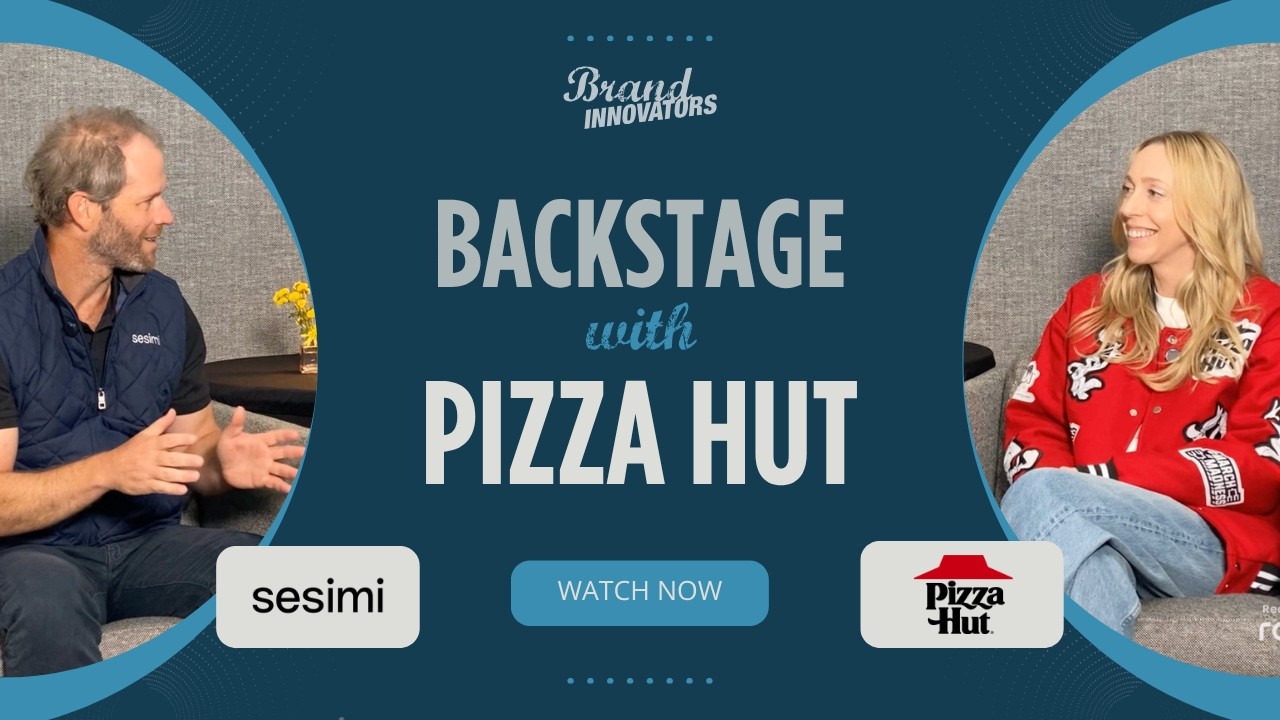
Full interview: How Pizza Hut approaches localisation, governance, and AI at scale
Campaign Ideas Are Only the Starting Point
Pizza Hut’s national campaigns demonstrate how brands anchor themselves in cultural moments. Activations around March Madness and Valentine’s Day focused on emotional relevance and shared experiences rather than product features.
The strategic intent behind the Peter Zahut campaign was that it represented “the role the brand plays in people's lives… helping feed good times and helping keep these special moments going.”
“That strategic thinking… is this activation around events or moments in time… making them really relevant at a moment in time… in your industry it’s all about the now. The challenge becomes how you operationalise that across locations consistently.”
— Andrew Baker, Founder and CEO, Sesimi
This reflects a broader shift. The constraint is no longer campaign ideation. It is the infrastructure required to translate central strategy into governed local execution at scale. This is where personalisation becomes critical. With 80% of consumers more likely to purchase from brands that tailor experiences to context, localisation is no longer optional. It is an operational requirement, particularly for organisations focused on scaling local marketing without slowing it down.
Across industries, the gap is not between strategy and creativity, but between strategy and operational execution across distributed teams. National campaigns set direction, but regional teams are responsible for translating that strategy into market specific content, offers, and timing.
Localisation Requires Structure
Franchise networks introduce execution complexity. Regional marketers develop campaigns, manage budgets, and tailor messaging. Central brand teams provide governance, assets, and amplification.
“Our local campaigns… are run by the franchise marketers in their respective organizations. The role of the brand marketing team is to partner with the franchisees… making sure the brand is showing up consistently and as per brand guidelines… we can help craft a personalized message, make sure it's getting targeted to those right people around that store list.”
— Katelyn Zborowski, Head of Brand Strategy, Pizza Hut
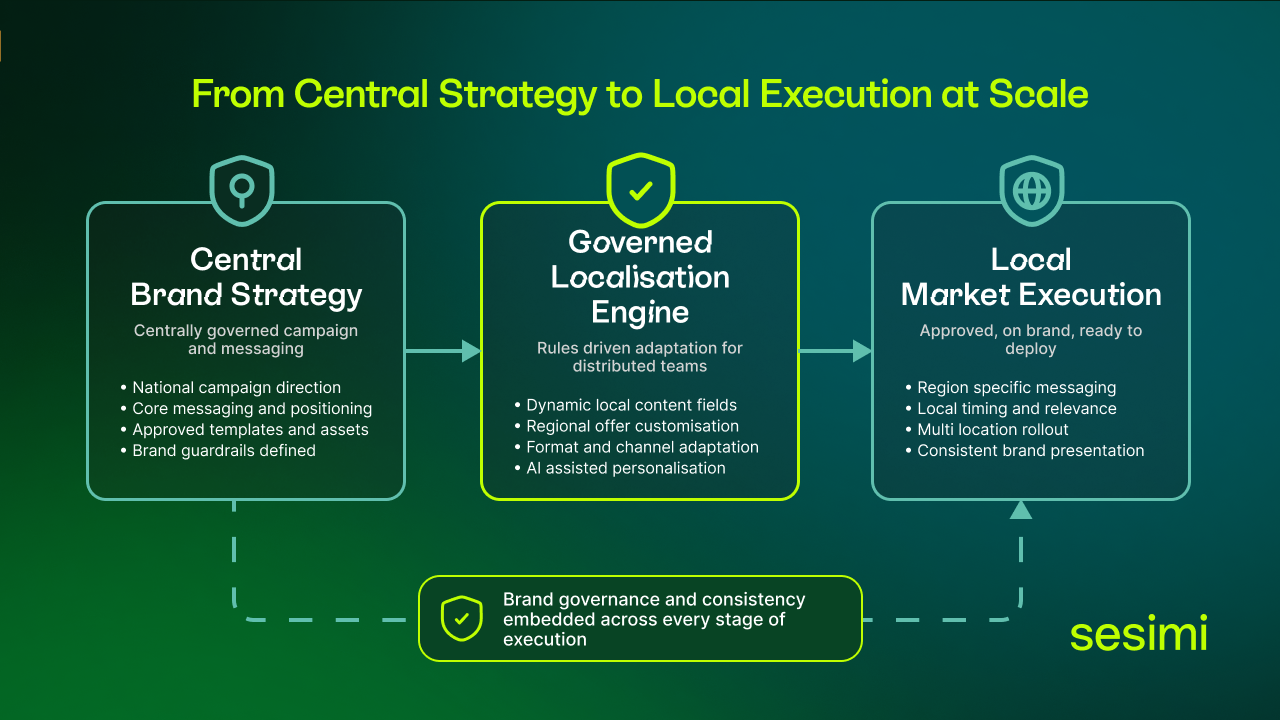 Operational model for governed localisation and distributed execution
This structure allows local creativity while protecting brand integrity. The financial impact of this consistency is significant. Consistent brand presentation across regions and channels can increase revenue growth by up to 23%, reinforcing the value of governance in distributed environments. This shift away from static brand documentation toward operational execution systems mirrors the approach discussed in upgrading the brand kit for channel scale.
Operationally, this model requires:
• Shared templates and assets
• Governance guardrails
• Local editing flexibility
• Central visibility into execution
Without these components, localisation creates inconsistency. With them, it becomes a performance lever.
Regional Relevance Drives Performance
The “Nothing Tops Texas” activation illustrates how localisation works when supported by shared infrastructure. Regional franchise marketers led the idea and funding, while the central team supported asset production, targeting, and data.
This operating model enables:
• Local relevance
• Brand consistency
• Faster execution
• Scalable campaign rollout
Without structured workflows, localisation often leads to fragmentation. With governance, it drives performance. This is increasingly relevant as multi location brands shift toward distributed content production models.
Consistency Requires Guardrails
Consistency does not mean uniformity. Katelyn Zborowski describes the need for flexibility within defined boundaries, noting that teams require “freedom… with some level of flexibility, but certainly we don't want to veer too far away from our North Star.”
This reflects the shift toward governed localisation. Central teams define messaging, assets, and brand rules. Local teams adapt execution to community context.
This approach allows brands to scale execution without sacrificing identity, a common challenge across franchise, dealer, and partner driven organisations.
AI Is Becoming Operational Infrastructure
The interview highlights how AI is moving from experimentation into daily workflows. Pizza Hut uses AI for ideation, concept testing, and behavioural targeting. AI accelerates planning and reduces manual work.
AI is described as “a miracle” for generating multiple concept boards and positioning options, improving efficiency in early stage planning.
This aligns with broader industry adoption. With 92% of marketing organisations now using AI to drive personalisation and operational efficiency, AI is becoming embedded in marketing infrastructure rather than treated as a standalone capability. This operational shift reflects broader practices explored in how marketers can use AI to innovate and grow.
Katelyn Zborowski also emphasises AI’s role in delivering “the right message, the right offer to the right person at the right time.”
AI is therefore not just improving creative ideation. It is enabling:
• Faster campaign iteration
• Behaviour based targeting
• Automated personalisation
• Operational efficiency for distributed teams
What This Signals for Distributed Brands
The interview surfaces four operational priorities:
- Campaign strategy must translate into scalable execution
- Local teams require flexibility within guardrails
- Shared assets and workflows enable consistency
- AI accelerates planning and personalisation
These priorities are increasingly consistent across franchise, retail, automotive, and multi location organisations. The pattern is clear: central strategy is not the limiting factor. The ability to operationalise that strategy across distributed teams is.
For organisations managing franchisees, dealers, partners, or regional teams, this becomes a structural challenge. Local teams need flexibility. Brand teams require governance. Marketing leaders need speed, consistency, and measurable execution.
This is why infrastructure is becoming central to modern brand management. The brands gaining advantage are those that can connect national strategy, governed localisation, and AI driven personalisation into a single operational model.
The Pizza Hut example illustrates how leading organisations are approaching this shift. It is not about one campaign or one brand. It reflects how distributed marketing is evolving — and the operational capabilities required to execute effectively at scale.
FAQ
Why is localisation important for franchise brands?
Local teams understand regional audiences and tailor messaging. Personalised, context relevant marketing increases engagement and conversion.
How do brands maintain consistency across regions?
Through shared assets, governance rules, and central oversight while allowing local adaptation within defined boundaries.
Where does AI deliver the most value today?
Ideation, concept testing, behavioural targeting, workflow automation, and personalisation across distributed marketing operations.
Related Topics
- AI in brand management
- Scaling local marketing in franchise networks
- Brand governance for distributed teams
If you would like to explore how creative automation fits within your content production workflow, book a short demo with the team.

Read other relevant blog posts:
 The Brand Recognition Paradox: Why More Content Doesn't Build Stronger BrandsPublishing more content does not automatically build stronger brands. Discover why consistency, distinctive brand assets, and disciplined execution create lasting brand recognition.
13 July 2026 • Sesimi Editorial
 OEM Marketing in 2026: Five Trends Redefining Brand Control and Dealer SpeedFive OEM marketing trends shaping 2026, covering creative automation, dealer execution, governance, and compliance at scale.
30 June 2026 • Sesimi Editorial
 Sesimi Wins the 2026 DXP March Madness CompetitionHow multi location brands scale globally while maintaining brand consistency, localisation, and operational control.
20 Apr 2026 • Sesimi Editorial