
Inside Sesimi - Latest News and Stories
Stay up to date with the latest news and insights from the Sesimi team.
What Channel Leaders Took Away from CMA 2026
Published on 30 Mar 2026 by Sesimi Editorial
CMA 2026 reinforced a structural shift in channel marketing. The focus has moved from distributing assets to enabling execution. Across sessions, the consistent theme was reducing friction so partners can actually go to market.
From co-branded campaigns to partner portal usability to segmentation by maturity, the discussion repeatedly returned to one priority: making partner marketing easier to activate and scale.
This shift reflects a growing focus on operational coordination and execution-ready enablement across distributed partner ecosystems.
In channel environments, hundreds or thousands of partners adapt campaigns locally, often under time pressure and without direct brand oversight. Documentation alone cannot enforce consistency, visibility, or measurable performance at that scale.
This is why many organisations experience growing tension between brand governance and execution speed. Partners need flexibility. Central teams need control. Traditional brand kits sit between the two, but they were never designed to operate as execution infrastructure.
Quick Stats from CMA 2026 |
| $26,000 average cost to acquire a new customer in partner-led growth models |
| 50% of partner ecosystem leaders report lack of resources to support partner marketing programs |
| 135+ languages achievable for partner campaign localization using AI-driven content frameworks |
Frictionless Partner Execution Is Now Table Stakes

Mike Thompson participating in a panel discussion at the Channel Marketing Summit 2026.
One of the most consistent insights across sessions was the need to reduce the effort required for partners to activate campaigns. Smaller partners often lack marketing teams, while more mature partners expect flexibility and customization. Programs that assume a one-size-fits-all model create friction for both groups.
Effective enablement models segment partners and provide tailored execution paths. Less mature partners benefit from automated, ready-to-launch campaigns. More sophisticated partners require customization options that align with their own voice and brand.
This segmentation-driven approach increases adoption and improves time to market. Providing assets alone is no longer sufficient. Partners must be able to deploy campaigns quickly with minimal effort.
Implications for channel marketers
- Reduce the number of steps required to launch campaigns
- Segment partners by maturity and capability
- Offer both automated and customizable campaign options
- Prioritize execution over asset volume
“Campaigns in a Box” Are Becoming the Default Enablement Model
Packaged campaigns emerged as a dominant enablement approach. These bundles allow partners to download, customize, and deploy complete marketing campaigns without building assets from scratch.
Campaign kits typically include email templates, social content, landing pages, and supporting visuals designed for quick co-branding. The ability to apply a partner logo and launch immediately significantly increases participation.

Mike Thompson speaking with fellow panelists during a live session at CMA 2026.
Campaigns also need to vary by partner sophistication. Smaller partners rely on fully automated versions, while mature partners expect the ability to customize messaging or integrate assets into existing workflows.
Scalability comes from packaging execution, not expanding content libraries. Structured, ready-to-launch campaign frameworks allow organizations to scale partner-led demand generation without increasing operational overhead.
Implications for channel marketers
- Build complete campaign packages rather than standalone assets
- Provide automated and customizable versions of campaigns
- Enable simple co-branding and localization
- Focus on deployability over content volume
Segmentation by Partner Maturity Drives Adoption
Another consistent theme was aligning enablement strategies to partner maturity levels. Smaller partners often require done-for-them marketing, while larger partners demand control and flexibility. Half of partner ecosystem leaders reported lack of resources as a major barrier to scaling partner programs, which helps explain why low effort execution models are gaining traction.
Programs that segment partners and deliver tailored enablement experiences see higher engagement and faster activation. Segmentation also influences onboarding, automation, funding, and campaign customization.
When partners receive enablement aligned to their capabilities, adoption increases and program ROI improves.
Implications for channel marketers
- Define partner maturity tiers
- Align campaigns and automation to each tier
- Provide low-effort options for smaller partners
- Offer flexibility for advanced partners
Partner Portals Must Prioritize Usability Over Volume
Partner portals were consistently discussed as execution hubs rather than content repositories. Usability, not content volume, determines engagement.
Partners expect:
- Easy navigation
- Centralized brand hub access
- Clear naming conventions
- Fewer clicks to launch campaigns
- Simple co-branding workflows
- Downloadable campaign kits
When portals are designed around actions rather than content categories, adoption improves.In one example shared at CMA, a portal engagement strategy drove a 35% increase in partner logins. The same effort resulted in 60% engagement from partners accessing portal resources, showing how strongly usability and communication affect activation.
This shift reflects the need to move partners from access to activation quickly. Automation-driven content delivery and AI-assisted localization further reduce friction when executing campaigns across distributed partner networks.
Implications for channel marketers
- Optimize portal UX for speed and clarity
- Structure navigation around partner actions
- Simplify campaign access
- Reduce clicks required for activation
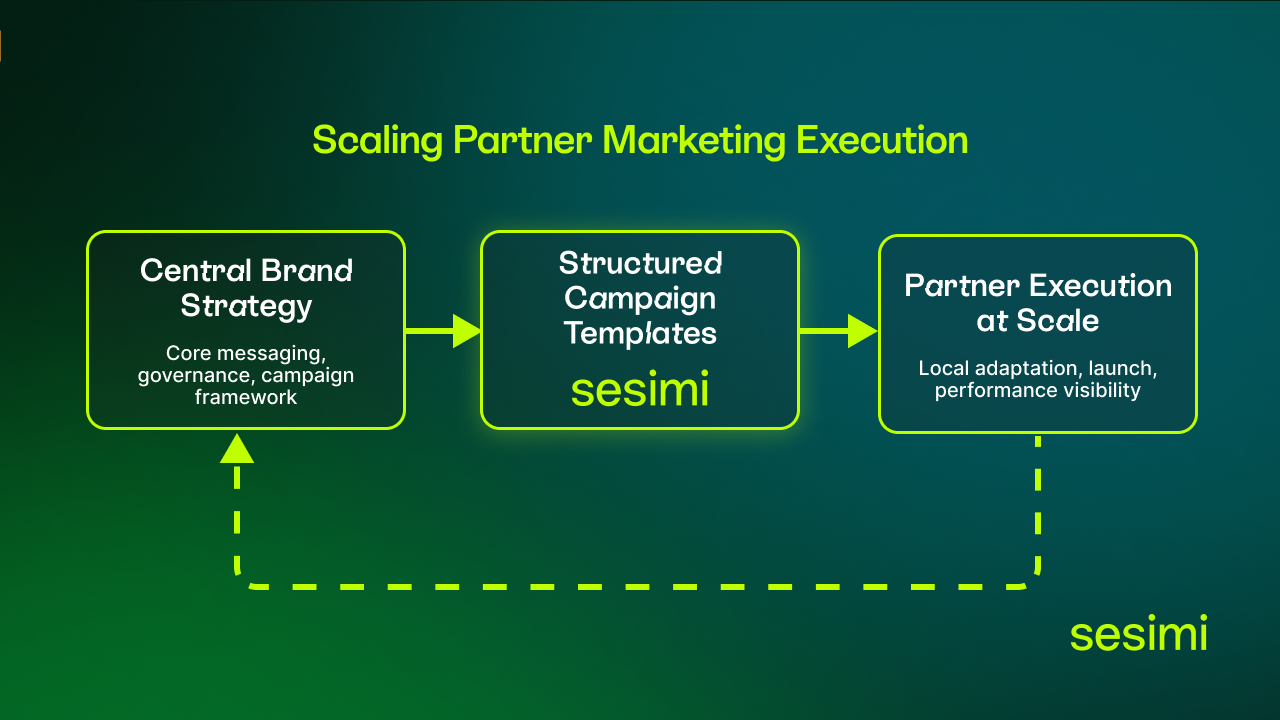
A simplified execution model showing how structured templates bridge central brand strategy and scalable partner-led campaign activation.
Analytics and Engagement Data Are Critical for ROI
Analytics surfaced repeatedly as a requirement for measuring program effectiveness. That pressure is increasing as customer acquisition costs now average $26,000, making it more important to prove that partner engagement programs are driving measurable return. Tracking partner activity provides visibility into adoption and helps justify investment.
Common metrics include:
- Partner logins
- Campaign downloads
- Asset engagement
- Campaign activations
- Portal usage trends
These metrics allow teams to identify active partners, refine enablement strategies, and demonstrate marketing impact.
Implications for channel marketers
- Track engagement metrics across partner programs
- Monitor campaign adoption
- Connect partner activity to pipeline outcomes
- Use data to optimize enablement
What This Means for Channel Marketing Leaders
CMA 2026 highlighted a clear shift toward operational simplicity and scalable execution. That shift is also being driven by buyer expectations, with 85% of buyers reported as dissatisfied with post sale provider experience and increasingly reliant on partners to deliver continuity and value. Successful programs are built around enabling partners to act quickly, not just providing content.
Buyer behaviour is also changing rapidly, with 95% of buyers now using generative AI during the buying process, which raises the importance of discoverable, well structured partner content and proof points. The most effective partner marketing strategies now:
- Reduce friction
- Segment partners by maturity
- Deliver campaigns in ready-to-launch formats
- Enable flexible co-branding
- Measure engagement and ROI
As partner ecosystems continue to grow, execution simplicity becomes more important than feature depth. Organizations that prioritize usability and scalable enablement will be better positioned to support partner-led growth. The commercial upside is material, with best in class MSPs averaging 22.6% EBITDA compared with -2.1% for bottom quartile peers, reinforcing the value of operational maturity and structured execution.
FAQ
What is the biggest shift in channel marketing highlighted at CMA 2026?
The biggest shift in channel marketing highlighted at CMA 2026 was the move from distributing assets to enabling partner execution.
Why are “campaigns in a box” becoming more important for partner marketing?
Campaigns in a box are becoming more important for partner marketing because they allow partners to quickly deploy ready-to-launch campaigns without building assets from scratch.
How does partner segmentation improve partner program adoption?
Partner segmentation improves partner program adoption by aligning enablement strategies with partner maturity and capability.
What role do partner portals play in modern channel marketing programs?
Partner portals play a central role in modern channel marketing programs by acting as execution hubs where partners can access and launch campaigns quickly.
Why are analytics becoming essential in partner marketing?
Analytics are becoming essential in partner marketing because tracking partner logins, downloads, and campaign activity provides visibility into adoption and program effectiveness.
Read the full Brand Kit Upgrade whitepaper
As partner ecosystems scale, the challenge shifts from producing more content to structuring brand assets so partners can deploy them consistently and quickly. Execution-ready templates, governed customization, and reusable campaign frameworks are becoming foundational to scaling through-partner marketing without increasing operational overhead.
The full whitepaper examines how structured brand systems support channel scale, including governance models, reusable template frameworks, and operational approaches for enabling partners to execute while maintaining consistency.

Download the Paper
Read other relevant blog posts:
 The Brand Recognition Paradox: Why More Content Doesn't Build Stronger BrandsPublishing more content does not automatically build stronger brands. Discover why consistency, distinctive brand assets, and disciplined execution create lasting brand recognition.
13 July 2026 • Sesimi Editorial
 OEM Marketing in 2026: Five Trends Redefining Brand Control and Dealer SpeedFive OEM marketing trends shaping 2026, covering creative automation, dealer execution, governance, and compliance at scale.
30 June 2026 • Sesimi Editorial
 Sesimi Wins the 2026 DXP March Madness CompetitionHow multi location brands scale globally while maintaining brand consistency, localisation, and operational control.
20 Apr 2026 • Sesimi Editorial