
Inside Sesimi - Latest News and Stories
Stay up to date with the latest news and insights from the Sesimi team.
Scaling Local Marketing Without Slowing It Down
Published on 23 Feb 2026 by Sesimi Editorial
Modern marketing is no longer limited by creativity. It is limited by how quickly approved campaigns reach the market. Every delay between approval and activation quietly erodes revenue, relevance, and competitive advantage.
For multi unit and franchise brands, this reality defines growth. Local teams operate in fast moving environments shaped by inventory, seasonality, and regional demand. Head offices are responsible for protecting brand integrity, compliance, and consistency across every location. Both sides are responding to real pressures. The challenge is not aligning intent. It is executing at speed, across scale, without introducing friction that slows activation or fractures performance.
In this context, marketing effectiveness is determined less by what is created and more by how efficiently it moves. Brands that can translate strategy into local execution quickly, predictably, and repeatedly gain a measurable advantage. Those that cannot lose momentum long before creative quality ever becomes the issue.
How to Reduce Execution Friction and Accelerate Local Activation
Local teams operate closest to the moment of demand. They see inventory shifts, competitive pressure, weather changes, and regional opportunities as they happen. Speed matters in these moments. Yet when every campaign requires manual adaptation, repeated approvals, or external reproduction, execution slows and opportunity is lost.
When head office introduces controls that rely on process rather than systems, timelines stretch. Creative sits in queues. Local teams work around delays to meet deadlines. The result is uneven rollout, inconsistent activation, and campaigns that arrive late or partially deployed.
The solution is to build an operating model where governance accelerates revenue instead of slowing it down. Speed and control are not opposites. When embedded correctly, control enables speed rather than restricting it.
High performing networks also focus on clarity and visibility. When local teams understand how campaigns are structured, how localisation is intended to work, and how performance is measured, execution becomes faster and more confident. Speed improves not through pressure, but through systems that remove uncertainty and friction at every stage.
Building Scalable Marketing Systems That Increase Speed Without Sacrificing Control
High performing brands turn local marketing into a predictable revenue engine by removing the delays that silently dilute campaign impact. Their focus is not on producing more creative, but on removing the friction that slows campaigns between approval and activation. This approach is built on three core principles that convert speed into measurable commercial impact.
First, they replace process heavy approvals with embedded guardrails. Approved creative frameworks are made immediately usable by local teams through systems such as Sesimi’s Brand Management System. Instead of requesting permission for every variation, teams work within predefined rules. This reduces delay, limits rework, and ensures every execution stays compliant by default.
Second, they automate adaptation rather than outsourcing reproduction. Local details such as offers, locations, pricing, and contact information are applied automatically within approved assets using Sesimi’s Creative Automation. This This eliminates costly production cycles, reduces agency spend, and allows campaigns to launch days earlier, when relevance and demand are highest.
Finally, they create shared visibility across central and local teams. Performance data, usage insights, and activation metrics are available in the same environment, allowing teams to understand what launches, what performs, and where execution slows. This transparency reduces duplicated effort and enables faster iteration based on real outcomes rather than assumptions.
Together, these principles transform marketing from a sequence of handoffs into a repeatable execution system. Control becomes automatic, removing brand risk without slowing momentum or overloading central teams. Revenue becomes more predictable because campaigns launch on time, everywhere.. Marketing effort translates more directly into revenue impact.
As creative operations scale, automation increasingly shifts from production support to decision support. AI now plays a role in standardising execution logic, reducing manual judgement calls, and creating consistency through systems rather than enforcement. This change reflects a broader movement toward intelligent brand infrastructure, where execution speed and governance improve together, as explored in AI in Brand Management.
Learn how leading multi unit brands use Sesimi to accelerate execution, reduce friction, and protect brand integrity across every market.
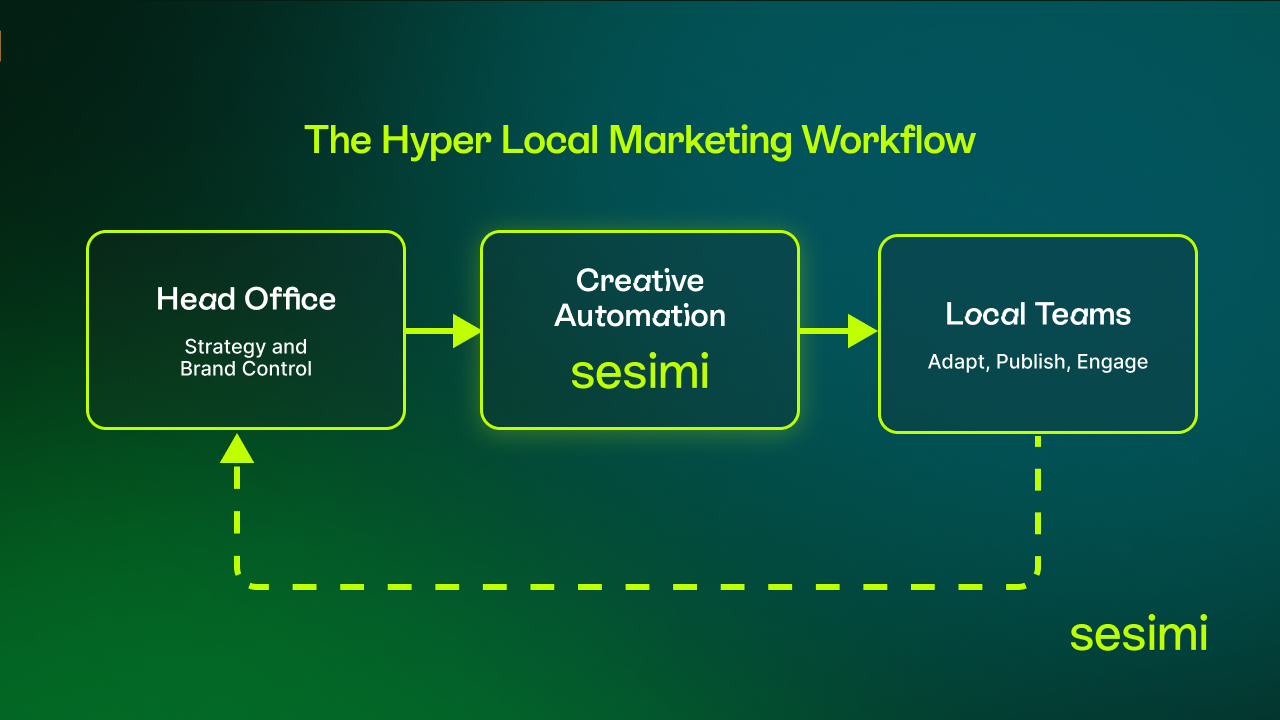
A visual summary of how Sesimi bridges strategy, automation, and local execution for scalable brand consistency.
Turning Marketing Strategy Into Measurable Revenue Through Faster Execution
Even the strongest marketing strategy breaks down if execution cannot keep pace. The gap is rarely strategic. It sits in the day to day mechanics of moving approved creative into market across dozens or hundreds of locations, each operating under different timing, demand, and operational constraints.
High performing brands close this gap by designing for execution first. They build repeatable systems that allow campaigns to move from approval to activation quickly and predictably. The objective is not more output, but less friction, so every location can act at the right moment without waiting on manual processes or external intervention.
A reliable execution framework typically follows three steps.
-
Create once, deploy everywhere.
Campaign assets are designed as flexible masters that can be activated immediately across markets. Variations are applied inside the asset rather than recreated downstream, ensuring every execution starts from an approved foundation and launches without delay.
-
Enable action with shared insight.
Local teams are given visibility into which campaigns activate fastest and perform best in comparable markets. This builds confidence and reduces hesitation, allowing teams to act quickly based on evidence rather than instinct.
-
Maintain a continuous feedback loop.
Execution data and local insight flow back to central teams in near real time. Head office gains visibility into where campaigns slow down or stall, while local teams feel supported by a system that responds to their reality rather than imposing rigid process.
When execution depends on human handoffs, scale introduces delay and inconsistency. Modern brand management replaces manual coordination with shared systems that embed rules, approvals, and variation logic directly into creative workflows. This shift reframes brand control as an operational capability rather than a review process, a theme central to the Value of Modern Brand Management.
Why Faster Execution Directly Increases Campaign ROI by Ensuring Relevance Peaks When Demand Does.
Despite advances in media buying and creative tooling, many brands are still constrained by how slowly campaigns move from approval to market. The gap between intent and execution has become one of the largest hidden drivers of underperformance. When timing slips, relevance drops and impact follows.
Execution speed is not just a qualitative advantage, it delivers measurable efficiency gains. Marketing automation has been shown to save teams an average of 2.3 hours per campaign, while reducing marketing overhead by more than 12 percent, freeing capacity for strategy and timely activation rather than manual coordination. At the same time, only 37 percent of marketing driven revenue impact is typically realised within a single quarter, underscoring how delays between approval and execution directly postpone commercial results.
The question is no longer whether brands should move faster, but how to do so without increasing risk or losing control.
The most effective organisations treat execution speed as an always on capability rather than a campaign specific effort. By designing workflows where approved creative can be activated immediately, and where variation happens inside controlled systems, they ensure every touchpoint launches on time, consistently, and with confidence. Whether the asset is digital, social, or in store, speed becomes part of the brand experience itself.
Execution speed matters most when marketing operates continuously rather than in discrete campaigns. In high volume networks, local relevance depends on the ability to activate quickly without rebuilding creative from scratch each time. Systems that support this model treat localisation as infrastructure, not effort, a pattern examined in Hyper Local Marketing at Scale.
Quick Stats |
|---|
| Marketing automation solutions have been shown to reduce marketing overhead by over 12%, demonstrating measurable operational efficiency gains. |
| Marketing automation saved marketers an average of 2.3 hours per campaign, freeing time for strategy and execution that matter. |
| A recent analysis found that only 37% of revenue impact from marketing activities is realised within a single quarter, highlighting how slow execution timelines can delay commercial results. |
FAQ
What slows marketing execution in large networks
Marketing execution is commonly slowed by manual creative adaptation, repeated approval cycles, agency handoffs, and limited visibility between central and local teams. These bottlenecks increase as networks scale, extending time to market and reducing campaign impact.
Why does execution speed matter in multi unit marketing
Execution speed directly affects relevance and performance. When campaigns launch late or unevenly across locations, opportunities are missed, messaging loses context, and commercial outcomes decline regardless of creative quality.
How does automation improve marketing execution speed
Automation accelerates execution by applying local details within pre approved creative assets. This removes manual reproduction, reduces errors, shortens approval timelines, and enables teams to activate campaigns faster while remaining compliant.
The Bottom Line
Marketing performance is increasingly shaped by how quickly brands can act, not just what they create.
When execution is slow, brand control feels restrictive. When execution is fast and predictable, control becomes an enabler of growth.
With the right systems, automation, and shared visibility, speed and consistency reinforce each other rather than compete. Brands that master this balance do not just launch better campaigns. They activate faster, everywhere, with confidence.
Sesimi supports multi unit brands and dealer networks across North America, Australia, and Canada, helping marketing leaders remove execution friction and align central control with local action.
The brands outperforming in 2025 will not simply create better campaigns. They will activate faster, capture demand earlier, and compound performance across every location.. They will have faster, more reliable execution engines.

Read other relevant blog posts:
 The Visibility Gap in OEM Dealer MarketingA practical model for giving dealers faster local campaign production while protecting OEM brand standards, data and marketing visibility.
1 Sept 2026 • Sesimi Editorial
 The Brand Recognition Paradox: Why More Content Doesn't Build Stronger BrandsPublishing more content does not automatically build stronger brands. Discover why consistency, distinctive brand assets, and disciplined execution create lasting brand recognition.
13 July 2026 • Sesimi Editorial
 OEM Marketing in 2026: Five Trends Redefining Brand Control and Dealer SpeedFive OEM marketing trends shaping 2026, covering creative automation, dealer execution, governance, and compliance at scale.
30 June 2026 • Sesimi Editorial