
Inside Sesimi - Latest News and Stories
Stay up to date with the latest news and insights from the Sesimi team.
The Brand Recognition Paradox: Why More Content Doesn't Build Stronger Brands
Published on 13 July 2026 by Sesimi Editorial

Marketing teams have never had more opportunities to publish content. Yet the brands customers recognise most easily are not necessarily the ones producing the most content. One of the largest studies of creative consistency, analysing 56 brands and responses from more than 624,600 consumers, found a clear relationship between consistent creative execution and stronger brand performance. Decades of brand effectiveness research show that recognition grows through repeated exposure to distinctive brand assets rather than constant novelty.
As AI continues to accelerate production, the competitive challenge is increasingly one of building systems that deliver consistent brand content at scale rather than simply creating more assets.
| Quick Takeaways |
|---|
| Research covering 624,600 consumers found a clear relationship between creative consistency and stronger brand performance. |
| The most consistent brands achieved a 70% Creative Consistency Score, reinforcing the value of repeated brand cues. |
| Recent Ehrenberg-Bass research benchmarked 1,162 distinctive brand assets, highlighting the growing evidence behind distinctive asset strategy. |
More Content Doesn't Create More Memory
People rarely remember how much content a brand published last month. They remember whether they recognised it immediately.
Recognition usually happens before a headline is read. Customers identify brands through distinctive cues such as:
- Colour palettes
- Logos
- Typography
- Photography styles
- Messaging and tone
Research from the Ehrenberg-Bass Institute benchmarked 1,162 distinctive brand assets across 128 brands, 21 product categories, four countries, and nine years, reinforcing the importance of applying these assets consistently.
Publishing more content does not automatically strengthen recognition. If every campaign introduces different visual treatments, messaging, or creative styles, customers spend more time working out who is speaking than remembering what was said.
Brands are remembered because they become familiar, not because they become prolific.
Recognition Is Built One Consistent Decision at a Time
Brand recognition is rarely built by a single campaign. It develops through hundreds of everyday interactions.
- A customer sees a sponsored post.
- Later they receive an email.
- A dealership shares a local promotion.
- A franchise publishes an offer on Facebook.
- Weeks later they visit a website or walk past a storefront.
Customers do not experience these as separate marketing activities. They experience them as one brand.
Every interaction either reinforces what they already remember or introduces something that competes with it. The strongest brands are recognised because each campaign feels unmistakably connected to the last.
Local Variation Slowly Weakens Brand Recognition
Maintaining that consistency becomes much harder across distributed organisations.
One dealership replaces approved campaign photography because local stock has changed. Another adjusts the logo to better fit a social post. A franchise creates its own promotional artwork because it needs something quickly. A regional office rewrites the campaign headline to better suit its market.
None of these decisions is likely to attract attention on its own. Together, they begin to change how the brand is recognised. Customers do not know which office created the campaign they are looking at. They only know whether it feels like the same brand they encountered yesterday. When every location makes slightly different creative decisions, those familiar visual and verbal cues become less consistent with every interaction.
Organisations that successfully scale global brands without losing brand consistency recognise that brand recognition is protected through everyday marketing decisions, not occasional brand refreshes.
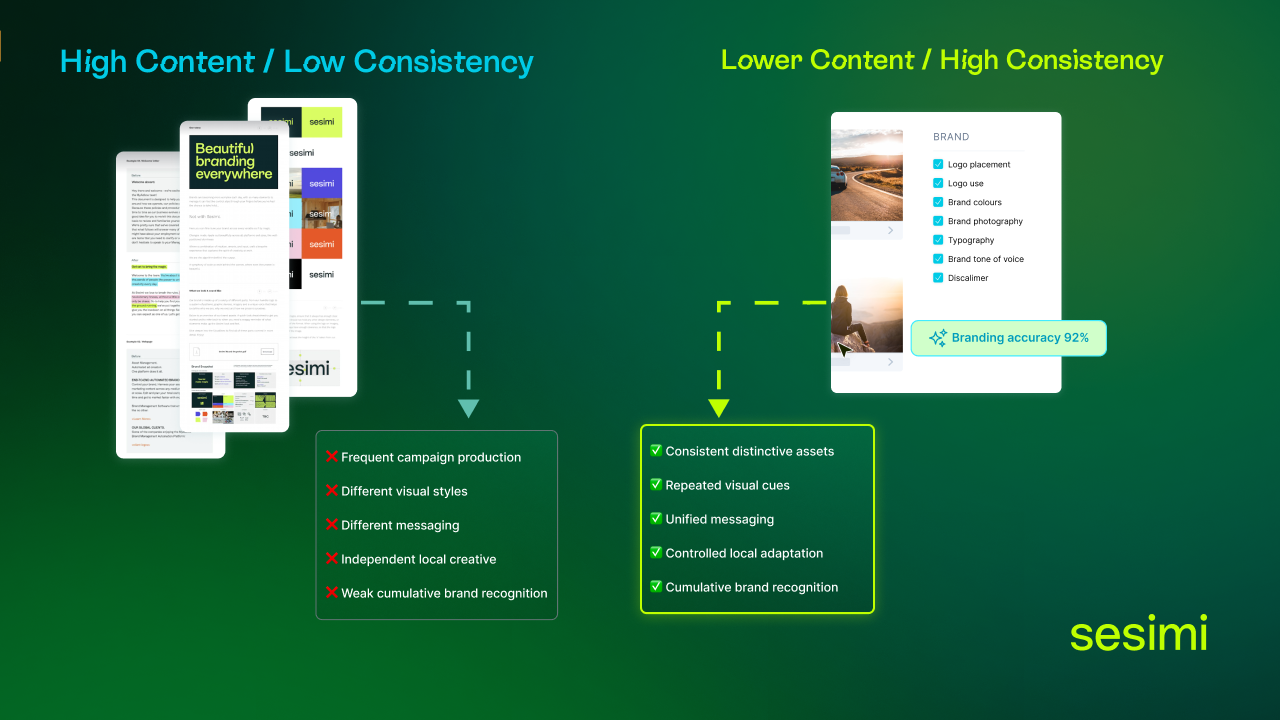
Publishing more content does not automatically strengthen brand recognition. Consistent use of distinctive brand assets creates stronger customer memory over time.
AI Has Changed the Challenge, Not the Goal
Artificial intelligence has dramatically reduced the cost and effort required to create content. Copy, imagery, translations, campaign variants, and local adaptations can now be produced in minutes rather than days.
That makes brand consistency more important, not less.
When creating new assets takes only a few minutes, organisations naturally produce more of them. Every new asset is another opportunity to reinforce the brand or introduce unnecessary variation. The pace of production increases, but the principles that build recognition remain the same.
Without approved assets, controlled templates, shared brand libraries, and review processes that fit naturally into everyday work, organisations can quickly fill every channel with content that looks and sounds slightly different.
Capabilities such as AI assisted content workflows with embedded brand controls help organisations increase content production while ensuring every new asset reinforces the distinctive brand cues customers already recognise.
Recognition Depends on Systems People Actually Use
Brand recognition is shaped by thousands of small marketing decisions made long before customers see a campaign:
- Can local teams find approved assets in seconds instead of searching through shared drives?
- Can they personalise campaigns without rebuilding them from scratch?
- Can marketing leaders see what every location is publishing before customers do?
- Can agencies, dealers, franchisees, and regional teams work from the same approved assets instead of creating their own?
These everyday decisions influence brand recognition far more than simply increasing the number of campaigns an organisation publishes. The same System1 research found that the highest performing brands averaged a 70% Creative Consistency Score, demonstrating that disciplined execution is a measurable competitive advantage rather than simply a branding principle.
Modern approaches to scaling local marketing recognise that local flexibility and brand consistency support one another. The easier it is for local teams to create approved marketing, the more consistently customers encounter the same distinctive brand cues, regardless of where they interact with the business.
Customers rarely notice when a brand is consistently executed but they notice when it isn't.
Brand Recognition Is Built Every Day
Content production will continue to become faster, cheaper, and easier. That is unlikely to change.
The challenge is making sure every new campaign reinforces what customers already know about the brand instead of asking them to recognise something new.
Customers rarely remember how much content a company published last quarter. They remember whether each interaction looked, sounded, and felt familiar.
Brands are not recognised because they create the most content. They are recognised because every campaign, in every location, contributes to the same memory customers have been building over time.
FAQ
Does publishing more content increase brand recognition?
No. Publishing more content does not automatically increase brand recognition. Brand recognition grows when customers repeatedly encounter the same distinctive brand assets across every campaign, channel, and location. Consistency reinforces memory. Content volume alone does not.
Why are distinctive brand assets important?
Distinctive brand assets are important because they help customers recognise a brand before they read a headline or message. Consistent use of colours, logos, typography, imagery, and other visual cues makes brands easier to identify and easier to remember over time.
Why is brand consistency difficult across distributed organisations?
Brand consistency is difficult across distributed organisations because campaigns are created and adapted by many people across different locations. Without approved assets, templates, and simple workflows, small creative changes accumulate until customers experience an inconsistent brand.
Build a More Recognisable Brand
Building brand recognition at scale requires more than great creative. It requires every location to work from the same approved assets, templates, and brand standards while still giving local teams the flexibility to create relevant marketing.
Sesimi helps distributed organisations make consistent brand execution part of everyday marketing, so every campaign strengthens recognition instead of introducing unnecessary variation.

Read other relevant blog posts:
 OEM Marketing in 2026: Five Trends Redefining Brand Control and Dealer SpeedFive OEM marketing trends shaping 2026, covering creative automation, dealer execution, governance, and compliance at scale.
30 June 2026 • Sesimi Editorial
 Sesimi Wins the 2026 DXP March Madness CompetitionHow multi location brands scale globally while maintaining brand consistency, localisation, and operational control.
20 Apr 2026 • Sesimi Editorial
 From National Campaigns to Local Execution, What Pizza Hut Reveals About Modern Brand ManagementHow multi location brands scale globally while maintaining brand consistency, localisation, and operational control.
13 Apr 2026 • Sesimi Editorial