
Inside Sesimi - Latest News and Stories
Stay up to date with the latest news and insights from the Sesimi team.
We ❤️ Brand Consistency: A Love Letter
Published on 17 Feb 2026 by Sesimi Editorial
We ❤️ Brand Consistency Because Good Brands Don’t Ghost Their Guidelines
Brand guidelines are not ignored because dealerships do not care about the brand. They are ignored because they sit outside the reality of dealership marketing. In automotive adjacent and franchise models, guidelines are often treated as reference material rather than operational infrastructure. A PDF. A portal. A slide deck. Useful in theory, distant in practice. When pressure hits, speed wins, and guidelines fade.
The dealership reality
Dealerships operate in constant motion. Offers change weekly, inventory shifts daily, campaigns overlap, and local competition remains aggressive. Dealers are expected to activate national campaigns, localise creative, update pricing, meet compliance requirements, and publish across multiple channels, often with limited time and support. They are responding to stock levels and sales targets in real time. In this environment, anything that slows execution becomes optional. Static brand guidelines do not survive contact with real workflows because they are not embedded in the tools and processes dealers actually use.
Dealer networks move faster when governance is built into execution, not bolted on afterward, which is why The Car Lot Doesnt Wait for Marketing focuses on real time dealership workflows.
How guidelines get ghosted
In automotive adjacent networks, brand rules usually live far away from execution. Brand standards are stored separately from creative tools. Tiered agency models introduce delays between national and local activation. Dealers manually localise national creative, adjust pricing, swap imagery, and then submit assets for approval. Regional processes vary, and review cycles add further friction. The guideline exists, but it is not applied by default. It relies on memory and manual checking. Each gap between guideline and execution increases risk. Each manual step pushes decision making downstream. Over time, dealers stop consulting documentation and start replicating what worked previously. Consistency becomes dependent on habit rather than structure.
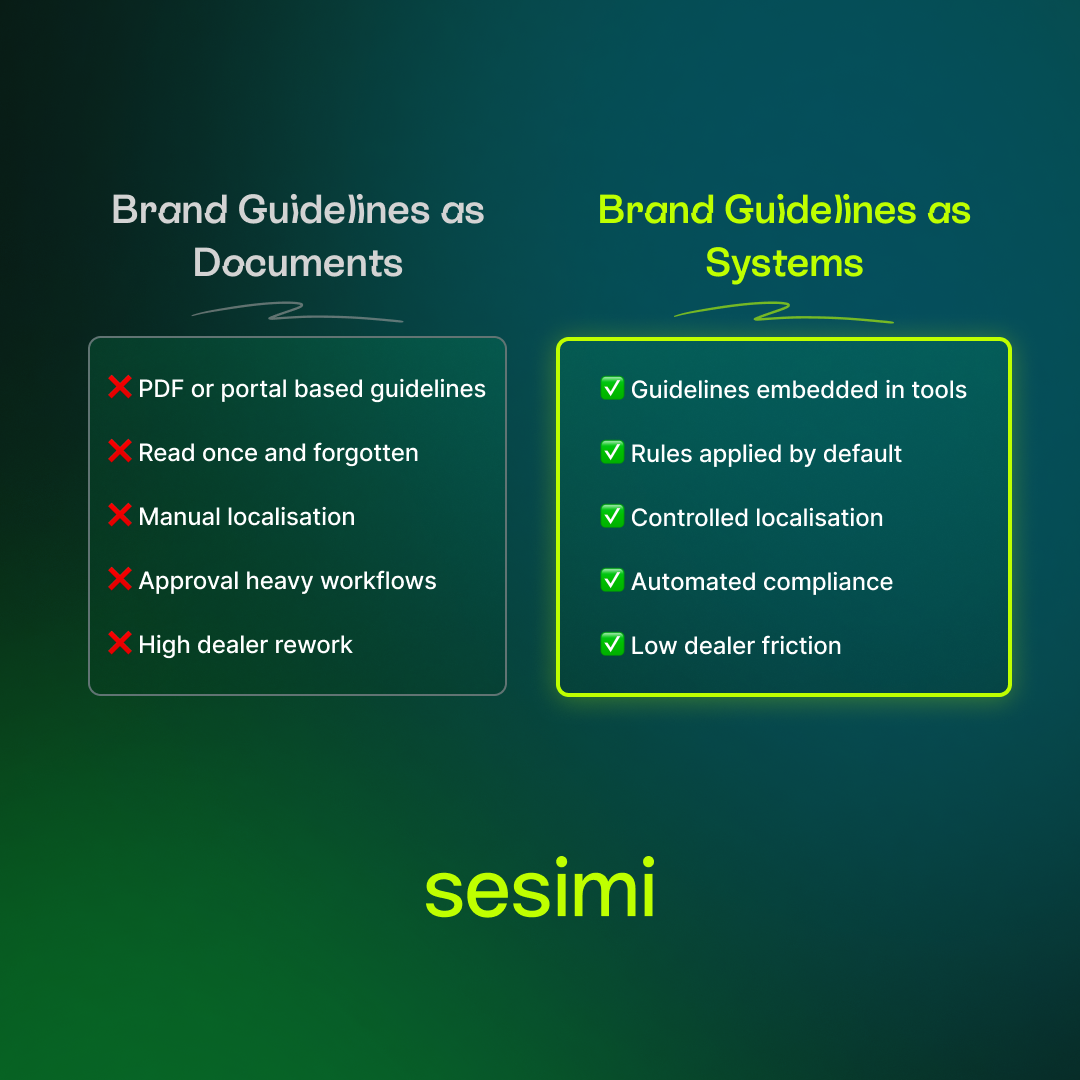
Why this breaks down at scale
OEM and franchise brands depend on volume. Hundreds or thousands of local executions may be required for a single campaign. Every campaign multiplies formats, offers, local variations, and compliance considerations across the network. When guidelines rely on manual enforcement, scale amplifies inconsistency. Dealers are effectively asked to act as brand managers. Approval queues grow. Rework becomes routine. Compliance becomes reactive rather than preventative. The issue is not dealer intent. It is the operating model. Systems that separate governance from execution cannot scale without friction.
The structural shift
Good brands stop asking dealers to remember rules and instead design systems where rules are already applied. Centrally governed creative is built for immediate dealer use. Formats are pre approved. Core brand elements are locked. Localisation is controlled through defined editable fields. Compliance checks occur within the workflow rather than after publication. Dealers do not need to consult a document before building an asset because they are working inside predefined guardrails. Guidelines move from reference material to operational defaults. This shift toward embedded governance mirrors the principles outlined in Hyper Local Marketing at Scale.
What this means for dealerships
When brand consistency is embedded in the workflow, dealerships move faster with less risk. Creative can be activated without repeated back and forth. Local updates can be made without compromising compliance. Approval requests decrease because assets are built correctly from the outset. Marketing teams spend less time correcting files and more time promoting vehicles and services. Consistency becomes an enabler of speed rather than a constraint on it.
What this means for OEMs and franchisors
For OEMs and franchise brands, embedded governance changes the dynamic across the network. Dealer adoption increases because friction decreases. Consistency improves because brand rules are applied automatically. Approval volumes reduce because fewer assets require manual review. Network visibility improves because activity occurs within a governed system. Brand consistency becomes an outcome of the operating model rather than a compliance exercise layered on top of fragmented tools. Structured automation and governance at network level are examined further in the AI In Brand Management Whitepaper.
Closing
We ❤️ brand consistency because good brands do not ghost their guidelines. They design systems where guidelines are inseparable from execution. In dealership and automotive adjacent networks, sustainable consistency comes from structure, not reminders.
Ready to modernize your dealer network? Discover how Sesimi’s Creative Automation and Digital Asset Management simplify automotive marketing from head office to showroom.
If you would like to explore how creative automation fits within your content production workflow, book a short demo with the team.

Read other relevant blog posts:
 What AADA 2026 Signals About the Future of Dealer MarketingExplore what AADA 2026 signals for dealer marketing, from local strategy + faster execution to smarter spending, connected systems + measurement.
11 Aug 2026 • Sesimi Editorial
 What's New: Smarter Planning and Stronger Content GovernanceFrom smarter planning to stronger governance, these updates simplify funding, reporting, content management, and marketing operations.
26 July 2026 • Sesimi Editorial
 Creative Bottlenecks Are Costing More Than You ThinkCreative bottlenecks quietly reduce marketing ROI. Learn how creative automation removes production delays, improves brand consistency and frees budget for growth.
19 July 2026 • Sesimi Editorial