
Inside Sesimi - Latest News and Stories
Stay up to date with the latest news and insights from the Sesimi team.
Creative Bottlenecks Are Costing More Than You Think
Published on 19 July 2026 by Sesimi Editorial
Marketing teams measure media performance, customer acquisition costs and campaign results with increasing precision. Far fewer measure the time and cost required to get campaigns into market.
Every campaign now generates more creative than it did only a few years ago. More channels, formats, audience segments and local variations mean more assets to design, review and approve. Those activities rarely appear in marketing dashboards, yet they determine how quickly campaigns launch, how much they cost to produce and how much marketing a team can deliver.
This is one of marketing's biggest hidden ROI problems. Organisations invest heavily in improving campaign performance while overlooking the production systems that determine how quickly good ideas become live campaigns.
| QUICK STATS |
|---|
| Creative professionals spend 20+ hours per week on repetitive design tasks that could be automated. |
| Marketing agency spend can be reduced by 25% while using AI to produce more campaigns. |
| Some experts expect generative AI to reduce marketing content production costs by 30% to 50%. |
Creative Production Has Become a Marketing Bottleneck
Campaigns now span more channels, audience segments and formats than ever before.
Research suggests marketing teams are launching 31% more campaigns year over year, increasing the volume of assets, approvals and creative variations every marketing team must manage. A single campaign may require hundreds, or even thousands, of creative assets, each adding another round of production, review or approval.
The bottleneck is rarely creativity itself. It is everything surrounding it.
Creative teams spend much of their time producing asset variations, resizing artwork for different platforms, responding to revisions, updating pricing and legal copy, managing file versions, and locating approved assets rather than developing new campaigns.
Much of this work moves campaigns through the organisation rather than improving them. As campaign volumes grow, these manual tasks consume more creative capacity, leaving less time for strategy, experimentation and original thinking.
Creative debt accumulates with every duplicated task, approval queue and manually produced asset variation. The work doesn't become more creative. It simply becomes harder to scale.
The Hidden Cost Isn't Creative. It's Everything Around It.
Marketing leaders usually know what they spend on agencies, media and software. Far fewer know what it costs to get creative from brief to campaign.
The expense isn't confined to design. It accumulates across the everyday work that keeps campaigns moving:
- Marketing managers coordinating approvals instead of planning campaigns.
- Designers recreating near identical assets for different channels and locations.
- Teams searching for approved logos, imagery and templates.
- Agencies producing routine localisation and formatting work.
- Campaigns sitting in approval queues while launch dates slip.
As campaign complexity increases, the consequences become harder to ignore. Research cited in The Value of Modern Brand Management found 87% of new marketing initiatives report performance issues, highlighting how operational complexity can undermine campaign execution. Individually, these tasks seem minor. Together, they consume thousands of hours that rarely appear in budgets or campaign reports. Every delay also reduces the time available for testing, optimisation and responding to market opportunities.
Research referenced in The Value of Modern Brand Management and by Adobe research found creative professionals spend more than 20 hours per week on repetitive design tasks that could be automated, showing how quickly routine production work can consume creative capacity before campaigns reach market.
This is marketing's real ROI blind spot. Most organisations measure campaign performance after launch but rarely measure the effort required to get campaigns into market.
Agency Spend Isn't Always the Problem
External agencies play an important role in developing campaign concepts, visual identities and creative direction. The challenge begins when highly skilled designers spend their time on work that doesn't require creative expertise.
Marketing teams routinely ask agencies and internal designers to resize artwork, create dealer or franchise variations, update pricing and promotional offers, replace contact details, produce regional versions and apply legal disclaimers.
These tasks require accuracy, consistency and speed, not new creative ideas.
As campaign volumes grow, so does this production work. Budgets that could fund new campaigns or stronger creative concepts are instead absorbed by repetitive adaptation, while agencies spend more time producing variations than developing ideas.
The potential savings are significant. Klarna reported reducing its marketing agency spend by 25% while using AI to produce more campaigns, showing how automation can redirect marketing budgets without reducing campaign activity.
Creative automation shifts that balance and approved templates generate compliant asset variations on demand, allowing designers to focus on concepts, storytelling, and creative quality.
The result isn't fewer creative professionals but better use of creative expertise.
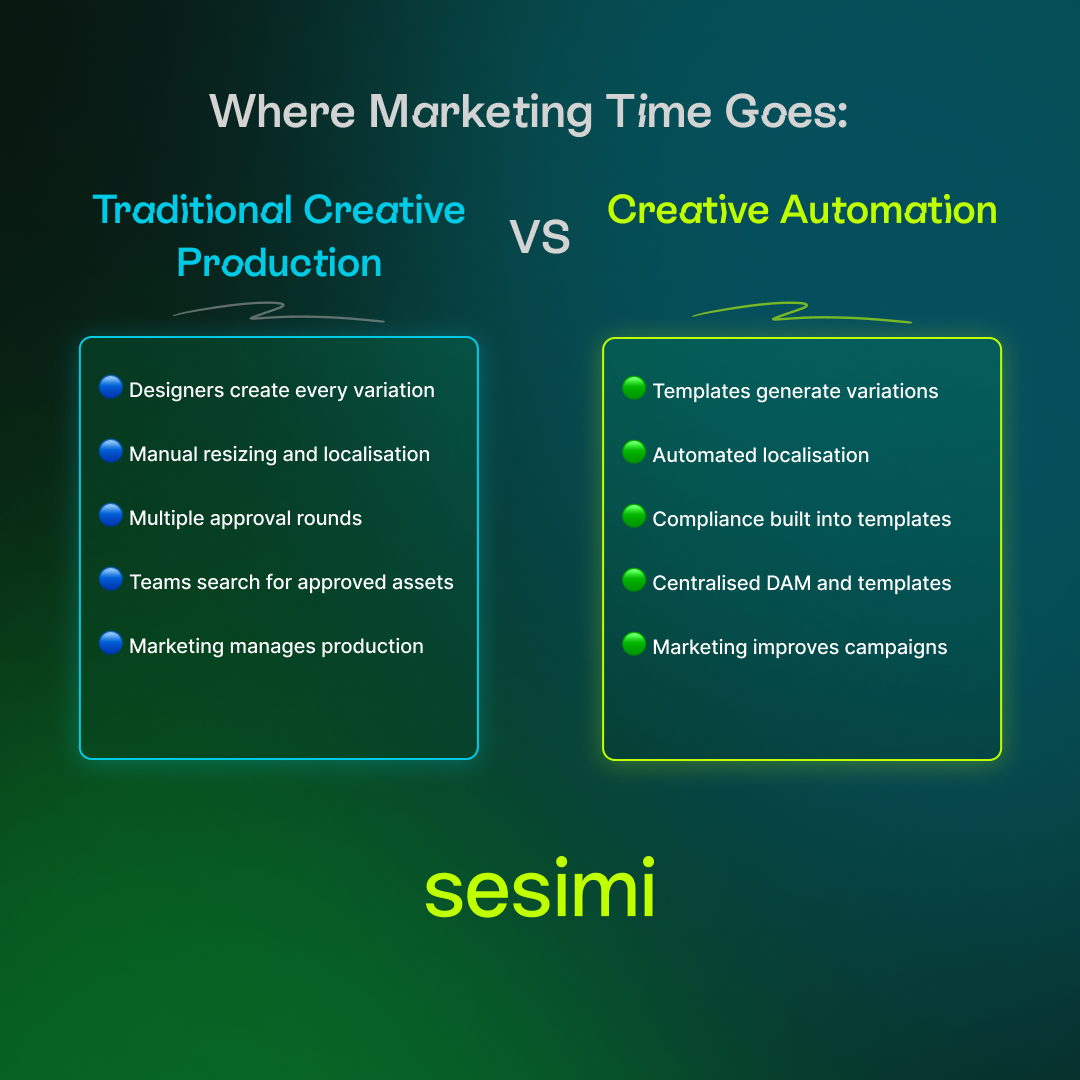
Traditional creative production requires repeated manual work, while creative automation shifts marketing effort towards campaign strategy, optimisation and growth.
Creative Automation Changes How Marketing Teams Spend Their Time
Creative automation doesn't just produce artwork faster. It reduces the time marketers spend managing production.
Removing production bottlenecks allows organisations to launch campaigns sooner, test more creative variations, localise campaigns at greater scale, respond faster to market changes and maintain stronger brand consistency.
The potential impact on production costs is substantial. Mondelēz expects its use of generative AI for marketing content production to reduce costs by 30% to 50%, demonstrating the scale of savings possible when repetitive production is automated.
The result extends beyond faster production. Marketing teams launch more campaigns, test more ideas, respond more quickly to market opportunities and spend more time improving campaigns instead of managing them.
Definition: Creative Throughput
Creative throughput is the amount of effective marketing an organisation can produce with its existing people, budget and technology. Increasing creative throughput means delivering more campaigns, more local relevance and more testing without increasing marketing resources.
Faster Production Creates Better Marketing
Creative throughput isn't measured by how quickly assets are produced. It's measured by how much effective marketing a team can deliver.
Creative throughput measures how much effective marketing an organisation can produce with its existing people and budget. Remove production bottlenecks, and marketing teams can:
- Launch campaigns sooner.
- Test more creative variations.
- Localise campaigns at greater scale.
- Respond faster to market changes.
- Maintain stronger brand consistency.
The value isn't measured in hours saved. It's measured in additional marketing. Faster production creates more opportunities to test, optimise and refine campaigns before the next one begins.
That advantage compounds over time. Local teams receive approved assets sooner. Central teams spend less time reviewing routine work and more time improving campaign performance. Marketing budgets shift away from repetitive production and towards activities that drive growth.
The organisations that outperform won't necessarily be those with the biggest marketing budgets. They'll be the ones that remove the friction between a good idea and a live campaign.
FAQ
Why do creative bottlenecks reduce marketing ROI?
Creative bottlenecks reduce marketing ROI by delaying campaigns, increasing production costs and limiting how much marketing teams can deliver with existing resources.
Does creative automation replace designers?
No, creative automation does not replace designers. It automates repetitive production tasks so designers spend more time developing campaigns instead of producing variations.
How does creative automation improve brand consistency?
Creative automation improves brand consistency by embedding approved templates and brand rules into every asset, allowing local teams to personalise campaigns without going off brand.
Remove Creative Bottlenecks Before They Reduce Marketing Performance
Many organisations underestimate how much creative production costs until they measure the time spent creating variations, managing approvals and coordinating assets across distributed teams.
Estimate your potential ROI with the Sesimi ROI Calculator and discover how reducing creative bottlenecks can free budget for strategy, media and growth.
Get a complete whitepaper outlining exactly how marketers are reclaiming thousands of hours, reactivating co-op dollars, and calculating all of this into measurable direct and indirect ROI.

Download the Full Whitepaper
Read other relevant blog posts:
 AI Systems Are Reshaping Brand Content DeliveryAI in brand management is redefining how leading organizations design, govern, and measure brands. This whitepaper maps the new strategic playbook for modern CMOs.
25 May 2026 • Sesimi Editorial
 Elevating Local Area Marketing Across Distributed NetworksDiscover how leading distributed brands are improving local marketing through better systems, faster execution, and measurable ROI. Key lessons from Sesimi and Taguchi.
28 Apr 2026 • Sesimi Editorial
 The ROI That Seems ImpossibleLearn how brand management technology drives measurable ROI by improving efficiency, brand consistency, and creative operations across enterprise teams.
8 Oct 2025 • Sesimi Editorial