
Inside Sesimi - Latest News and Stories
Stay up to date with the latest news and insights from the Sesimi team.
AI Systems Are Reshaping Brand Content Delivery
Published on 25 May 2026 by Sesimi Editorial
How Intelligent Systems Are Reshaping the Way Brands Deliver
Marketing teams are under pressure to deliver more campaigns, across more channels, with fewer resources. At the same time, expectations around performance, compliance, and brand consistency continue to rise.
Most organisations are still relying on fragmented tools and manual workflows to meet that demand. The result is slow execution, inconsistent output, and rising operational cost.
AI is not changing what marketing teams are trying to achieve. It is changing how that work gets done, shifting brand management from manual coordination to system-driven execution.
| Quick Takeaways |
|---|
| 30%+ increase in ROI for platforms with embedded AI |
| 50% faster asset discovery with AI tagging and search |
| 43% of marketers struggle to measure cross-channel impact |
AI is shifting brand management from tools to systems
AI delivers the most value when it is embedded across the entire brand management lifecycle. Not as isolated tools, but as connected systems that support planning, production, distribution, and reporting.
This shift is already changing how modern brands operate. Instead of reacting to bottlenecks, teams are building environments where execution happens faster by default. This reflects a broader move toward systems that enable local marketing at scale without slowing execution, where manual coordination is replaced by structured workflows.
AI becomes an infrastructure investment that enables scale, consistency, and speed across the campaign lifecycle.
Execution breaks down when systems do not connect
Most operational friction does not come from strategy. It comes from the gaps between systems.
Planning lives in one place. Assets live in another. Compliance is handled manually. Reporting is stitched together after the fact.
This fragmentation creates delays, duplication, and inconsistency across markets. It also limits a brand’s ability to scale local execution without losing control.
Static documentation cannot support dynamic execution environments. Brands are increasingly moving toward brand systems that enforce rules directly within workflows, rather than relying on manual adherence.
AI enables scalable localisation without loss of control
The core challenge in brand management is balancing central control with local flexibility.
AI addresses this by embedding rules directly into workflows. Templates enforce brand structure. Intelligent systems validate compliance. Local teams can adapt content without breaking guidelines.
This allows distributed networks to move faster while maintaining consistency. It also reduces the reliance on central teams to review, approve, and correct output.
This is particularly critical in distributed environments, where real-time local execution must keep pace with inventory, demand, and market conditions.
How AI applies across the brand lifecycle
AI is not a single capability. It applies differently at each stage of brand management, creating cumulative impact when connected.
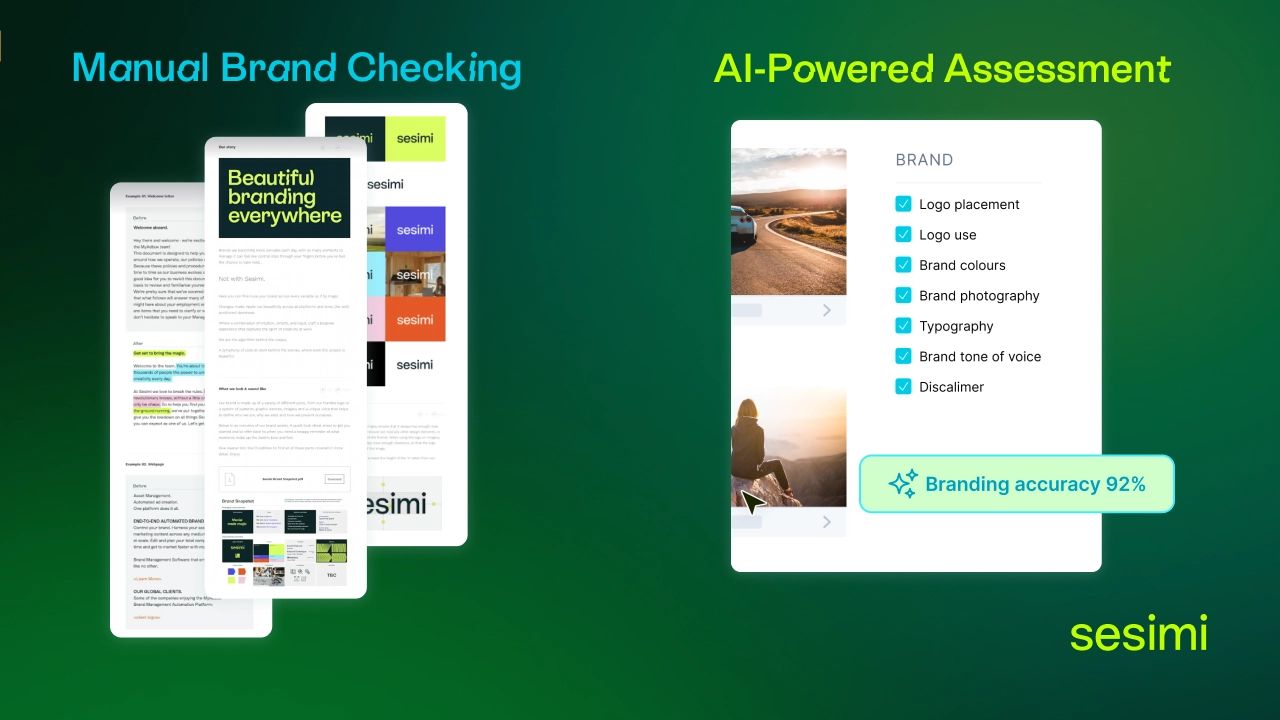
- Strategic development uses AI to surface audience insights
- Planning uses AI to optimise budget allocation and channel mix
- Asset management uses AI for tagging, search, and version control
- Creative operations use AI to accelerate localisation and production
- Compliance uses AI to validate assets against brand and legal rules
- Funds management uses AI to verify claims and detect anomalies
- Reporting uses AI to unify data and generate actionable insights
Each layer improves speed and accuracy. Together, they create a system where campaigns can scale without increasing operational overhead.
What this means for marketing teams
- Deliver more campaigns without increasing headcount
- Scale local execution without losing brand control
- Reduce compliance risk through automated validation
- Remove manual bottlenecks across planning and production
- Gain clear, unified visibility into performance and impact
This is the shift from managing marketing to operationalising it. Instead of coordinating disconnected tools and teams, marketing becomes a structured system where planning, production, compliance, and reporting are connected by design.
For teams operating across regions, partners, or franchise networks, this changes what scale actually looks like. More output does not mean more complexity. It means better systems.
Download the one page summary to see exactly where AI delivers the fastest impact, how it applies across the brand lifecycle, and what to prioritise first.
FAQ
What is AI in brand management?
AI in brand management is the use of intelligent systems to support planning, production, compliance, and reporting across the campaign lifecycle.
How does AI improve brand consistency?
AI improves brand consistency by embedding brand rules into templates, workflows, and validation systems, ensuring outputs remain compliant without manual review.
Where does AI have the biggest impact in marketing operations?
AI has the biggest impact in marketing operations when it is applied across the full lifecycle, particularly in localisation, compliance, and reporting where manual processes create bottlenecks.

Download Your Resource
Read other relevant blog posts:
 Creative Bottlenecks Are Costing More Than You ThinkCreative bottlenecks quietly reduce marketing ROI. Learn how creative automation removes production delays, improves brand consistency and frees budget for growth.
19 July 2026 • Sesimi Editorial
 Elevating Local Area Marketing Across Distributed NetworksDiscover how leading distributed brands are improving local marketing through better systems, faster execution, and measurable ROI. Key lessons from Sesimi and Taguchi.
28 Apr 2026 • Sesimi Editorial
 The ROI That Seems ImpossibleLearn how brand management technology drives measurable ROI by improving efficiency, brand consistency, and creative operations across enterprise teams.
8 Oct 2025 • Sesimi Editorial